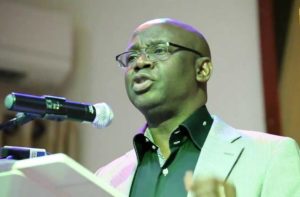
The Lead Pastor of the Citadel Global Community Church, Tunde Bakare, has asked the Nigerian government to suspend all non-essential gatherings in vulnerable areas nationwide and place them under emergency patrols as a way of tackling the country’s unabated security crisis.
He also accused Nigeria’s political class of neglecting the daily suffering of citizens and paying “little attention to the real work of governance,” describing it as “a stain on the Nigerian government” that external pressure was needed before officials responded to national issues.
He said this during a State of the Nation broadcast on Sunday in Lagos. The speech was titled, “The Darkness before Dawn.” He made the broadcast periodically.
For over a decade, Nigeria, Africa’s most populous country, has been bedeviled by security challenges, including terrorism, banditry, secession agitation, kidnapping and militancy.
Bakare, a trained lawyer, stated that while suspending all non-essential gatherings in vulnerable areas may appear as militarisation of the affected communities, it remains an essential and temporary step to check terrorism in the country.
“The suspension of mass gatherings and increased emergency patrol measures must be taken to prevent further mass kidnappings,” he said.
He lamented that terrorists have intensified their attacks on Nigerians from the time President Donald Trump of the United States announced the redesignation of Nigeria as a “Country of Particular Concern” over allegations of a government-tolerated killing of Christians.
He said the US president used “the most despicable language ever used by a world leader” to describe Nigeria as a “now-disgraced country.”
He said the government’s sudden “flurry of activity after Trump’s remarks” only highlighted its earlier indifference to citizens’ plight.
He recounted: “In a space of one week, troops were ambushed and some killed, dozens of secondary school students abducted in Kebbi, worshippers in a Church in Kwara attacked, kidnapped, some killed, and hundreds of students from St Mary’s Catholic School in Papiri town, Niger State, kidnapped.
“The level of insecurity seems to have worsened in response to the global focus on Nigeria as terrorists and bandits brazenly dared the Nigerian state.
“While we rejoice at the release of some of the kidnapped victims, including the Kebbi schoolgirls and the Kwara church worshippers, as well as the escape of some of the pupils kidnapped in Niger, the continued attacks on communities further underscore the need for fundamental interventions.
“These interventions go to the very essence of our nationhood and the quality of governance in both domestic and foreign policy contexts.”
Bakare said years of leadership failure to confront the nation’s underlying crises had finally reached their peak.
He accused Nigerian leaders of “burying their heads in the sand like ostriches,” claiming they remained “preoccupied with the politics of chaos” instead of delivering effective governance.
The cleric criticised the National Assembly for what he described as its lack of initiative at a time of national crisis.
“It is a shame on our National Assembly that it took the United States Congress, not the representatives elected by Nigerians, to convene a hearing on the lived experiences of citizens suffering under insecurity while those in Abuja were busy with politicking, posturing for relevance, and defecting from one political party to another in desperate manoeuvres to secure their seats ahead of the 2027 elections.”
Stronger Nigeria
He also noted that an integrated approach is needed to position Nigeria strategically in the shifting global order, adding that it is one that would involve a critical review of our governance structure, security architecture and geo-economic strategy.
“From convening the Save Nigeria Group to accepting the invitation to be running mate to late President Muhammadu Buhari, to sponsoring the Nigerian Charter for National Reconciliation and Integration at the 2014 National Conference, I have been guided by a realisation.
“The best of the North and the best of the South must come together at the table of brotherhood to forge a strong and united Nigeria,” he said.
The popular cleric said it is the failure of state institutions over the years that transformed a local revolt into a vicious terrorist movement and other unresolved grievances.
“The state’s failure over decades to address long-standing disputes between Hausa farmers and Fulani pastoralists allowed local tensions to mutate into a sophisticated and deeply entrenched network of terror.
“Whether the violent attacks are motivated by land grab, ethnicity, religion, or all of the above, the situation is the height of failure to guarantee the security and welfare of the Nigerian people.
“The Nigerian state has a responsibility to invade camps of armed marauders who hide under the cloak of herdsmen of whatever ethnicity, and who invade defenceless communities and gleefully massacre unarmed men, women and children.
“From the Indigenous People of Biafra (IPOB) to the Eastern Security Network (ESN), to the so-called unknown gunmen, the reaction has ranged from a revolt against the Nigerian state to sheer criminality.
“The trial and sentencing of Biafran separatist, Nnamdi Kanu, which took place at the same time that Donald Trump shifted the world’s attention to Nigeria, has tended to reopen old wounds.
” It is time for Nigeria to truly heal from the Civil War. It is time for the Nigerian state to take concessionary steps to ensure equity for the South East.
Creation of new states
Bakare also said a group of progressive Nigerians at the 2014 National Conference took a convincing position that there was no need for more states in the country. According to him, what was needed was the consolidation of states into geopolitical zones.
He said, “We strongly believed that what was needed was the consolidation of states into geopolitical zones, rather than the further balkanisation of non-viable states.
“However, for the sake of trustful give-and-take, and in the spirit of equity, we, at the Committee for Political Structure and Forms of Government, aligned with our Committee Chairman, elder statesman, retired Gen. Ike Nwachukwu, and advocated an additional state for the South East.
“Concessions such as these will lay the groundwork for genuine integration and inclusion in the South South, which includes Akwa Ibom, Bayelsa, Cross River, Delta, Edo, and Rivers. Years of environmental degradation and resource control disputes led to militancy.”
The cleric insisted that Nigeria needs restructuring to ensure cohesion and unity.
“While we acknowledge ongoing efforts of President Bola Tinubu to swiftly address the situation—from the declaration of emergency on security to mass recruitment into the police force—we urge him to rise to the occasion and restructure Nigeria.
He called on the Nigerian government to apologise to and pay compensation to victims of terrorism across the country.
“This would entail opening a Victims and Survivors Register and the President would tender an apology on behalf of the Nigerian state to communities across the nation, calling each community by name, and, possibly, some of the families most gruesomely hit in the attacks.”
State Police
On the quest for the creation of state police, the pastor asked President Tinubu to allow the state governors to lead the process.
“A nationally driven approach to devolution of policing powers will ensure that the right checks and balances are put in place to prevent subnational executive overreach.”