


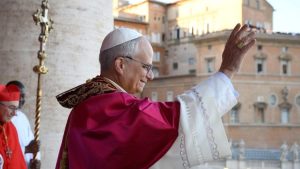
Cardinal Robert Francis Prevost, an American, has been elected as the new Catholic pope.
Prevost was elected by about 133 cardinals, who gathered at the Casa Santa Marta to cast their ballots in the Sistine chapel.
White smoke was seen rising from the chapel’s chimney on Thursday, two days after the conclave officially commenced, signalling the emergence of a new pope.
The conclave is an ancient process used by the Catholic church to elect e new pontiff.
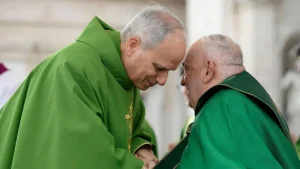
The new Catholic head, who will be known as Pope Leo XIV, succeeds Pope Francis, who died at 88 on Easter Monday, April 21.
Prevost’s public installation Mass will take place on May 18.
First address
Shortly after his emergence as pope, Prevost gave his first address “Urbi et Orbi” blessing to the thousands of worshippers at St. Peter’s Square, saying “Peace be with you all. I, too, would like this greeting of peace to enter into your heart to reach your families, all people, wherever they may be, all peoples, all the earth.
He paid tribute to his predecessor. He said, “We still hear in our ears the weak but always courageous voice of Pope Francis, who blessed us.”
Prevost urged the worshippers to “build bridges with dialogue, with encounter, uniting us all so as to be one peoples always in peace.”
What to know about the new Pontiff
Prevost, 69, was born on September 14, 1955.
He hails from Chicago in the United States of America though born to parents of Spanish and Franco-Italian descent.
He served as an altar boy and was ordained in 1982.
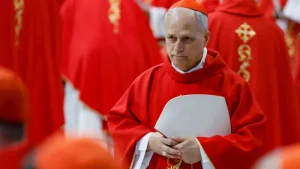
He is the first American Pope in the history of the Catholic Church.
The new pope will be the 267th Vicar of Christ.
He spent over two decades as a missionary in Peru and became a naturalised citizen, deeply connected to Latin America
He holds a bachelor degree from Villanova University, a masters from the Catholic Theological Union and a doctorate in Canon Law from the Pontifical University of Saint Thomas Aquinas.
From 2001 to 2013, he led the Augustinian Order overseeing missions in nearly 50 countries.
In 2023, he became head of the Vatican office responsible for selecting bishops worldwide.
He is an advocate for Synodality supporting a church that listens, walks together and embraces diversity.
Theologically, he is a centrist, progressive on social issues but traditional on doctrinal matters.
He speaks eight languages and brings a global perspective to his role.